Why Your Softball PNG Deserves a Better Design Workflow
Whether you are designing uniforms for a local league, creating merchandise for a weekend tournament, or building a digital scrapbook for a season of memories, a high-quality Softball PNG offers incredible creative flexibility. The promise is straightforward: a crisp graphic with a transparent background, ready for t-shirts, sublimation, cards, and web graphics. However, the difference between a file that just sits on your hard drive and a design that wows your audience often comes down to understanding a few critical technical details and common oversights. This article walks through the frequent pitfalls and how to turn them into confident, professional design decisions.
Understanding What Makes a Softball PNG Valuable
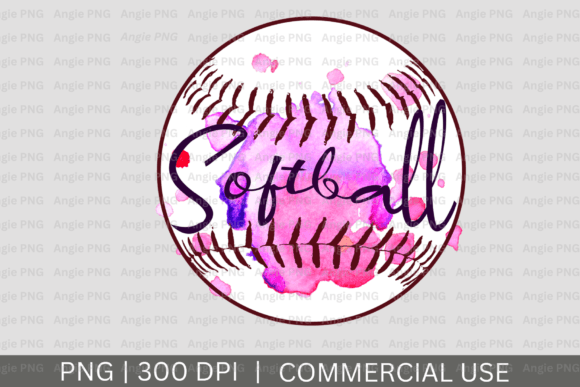
A Softball PNG is a raster image, which means it is built from pixels. The two key specifications—transparent background and 300 dpi—are what make this file suitable for serious print work. The transparency allows you to drop the graphic onto any colored background in your design software without an ugly white box around it. The 300 dpi resolution ensures that the image stays sharp when printed on standard items like t-shirts, tote bags, greeting cards, or invitations.
It is equally important to recognize what this file is not. As the description notes, "This is NOT an SVG file and cannot be used as one." You cannot infinitely scale it without losing quality. Understanding this limitation is the first step toward choosing the right tool for every project. This particular graphic is perfect for a wide range of uses—sublimation products, digital scrapbooks, blogs, web design—but it thrives when its strengths are matched to the right output.
Pitfall 1: Treating a Raster PNG Like a Vector SVG
The most common misunderstanding we encounter is the assumption that a 300 dpi PNG can be stretched to any size without consequences. A user might buy this Softball PNG for a small t-shirt design and later try to use it for a large poster or banner. Because a PNG is made of pixels, enlarging it beyond its original dimensions forces the software to create new, interpolated pixels. The result is a blurry, soft, or "pixelated" image that looks unprofessional.
The correct approach: Plan your final output size before you begin designing. If you are creating a standard 12x12 inch sublimation print or an 11x14 inch poster, this Softball PNG is an excellent choice. If your project requires large format printing over 24 inches, you need a vector file or a much higher resolution raster source. Knowing this distinction saves you the frustration of a failed print run and wasted materials.
Pitfall 2: Assuming the File Does the Work for You
A beginner might purchase a Softball PNG expecting to easily edit individual elements—changing the color of the stitches or removing the seam—in a basic photo viewer. The description explicitly advises, "Please make sure you have the required software and knowledge to use this graphic." A PNG is a flat, composite image. You cannot alter its components without the skills and tools to mask, select, and recolor within a proper design application like Adobe Photoshop, GIMP, Affinity Photo, Canva Pro, or Procreate.
The correct approach: Before you download, honestly assess your comfort level with your chosen software. If you are new to design, invest a little time in learning basic techniques such as using clipping masks or adjustment layers. There are countless free tutorials for "how to recolor a PNG" or "how to isolate an element." This small investment in your skills multiplies the value of every digital asset you buy. The file is a high-quality starting point, but your knowledge determines how far you can take it.
Pitfall 3: Ignoring the Reality of Color Variation
Few things disappoint a creator more than seeing a vibrant softball graphic on their monitor, only to receive a print that looks dull or shifted in hue. "Colors may vary between devices and printers." This is not a flaw of the Softball PNG; it is a universal truth of digital color management. Your monitor displays in RGB (Red, Green, Blue), while most commercial printers use CMYK (Cyan, Magenta, Yellow, Black). Many bright RGB colors simply fall outside the range of printable CMYK pigments.
The correct approach: If you are designing for print, work in CMYK color mode from the very start of your project. Most professional design programs let you soft-proof the image, simulating how it will look when printed on a specific material. If color accuracy is critical for your brand or team, order a physical test print before committing to a large batch. This simple step accounts for the color profile of both the printer and the substrate, whether it is a cotton t-shirt, a sublimation mug, or a polyester banner.
Pitfall 4: Overlooking the Sublimation Workflow
The description correctly states that this design is "perfect for sublimation products." This leads many to believe the PNG is all they need. In reality, the graphic is just the artwork component. Sublimation is a complete chemical process requiring specialized ink, specific transfer paper, high heat, and precise pressure. It bonds best with polyester fabrics or polymer-coated hard goods. A beautiful 300 dpi Softball PNG will fail to transfer correctly if your printer is loaded with standard ink, or if you are pressing onto a 100% cotton shirt.
The correct approach: Use the Softball PNG as your premium artwork source. Export it as a high-resolution file suitable for your sublimation design software. Then, verify that your entire production pipeline is compatible: sublimation ink, the correct paper, and the right heat press settings for your specific material. The graphic itself is a star asset, but it needs a properly equipped production workflow to deliver a winning result.
Pitfall 5: Neglecting to Verify File Specifications and Licensing
Many users download a graphic assuming it is print-ready without checking the fine print. Does it actually have a transparent background, or is there a white halo? Is the resolution genuinely 300 dpi, or is it a 72 dpi web graphic stretched to fit? The description for this Softball PNG clearly states it has "a resolution of 300 dpi" and "a transparent background." It also explicitly states, "This is NOT an SVG file." These details matter deeply for your project's success.
The correct approach: Always verify the technical specifications of a file before purchasing. Check the seller's terms of use regarding commercial rights, especially if you plan to sell your finished products online. This simple due diligence protects your projects both technically and legally. A clear understanding of what you are buying prevents interruptions to your creative flow and builds a stable foundation for your work.
Practical Steps to Maximize Your Results
To get the most out of your Softball PNG, integrate these habits into your regular design routine:
- Pre-flight your files. Open the PNG in your software and confirm the canvas size, resolution, and color mode before you start building your composition.
- Work non-destructively. Keep the original Softball PNG file untouched. Duplicate the layer if you need to make changes, so you always have the original to fall back on.
- Resize with care. When scaling the image, hold the Shift key to maintain the correct proportions. If you need to make it significantly larger, consider whether a vector source would be better suited for future projects.
- Export for the destination. Use the 300 dpi original for all print work. If you are using the graphic on a blog or a website, save a separate 72 dpi version to keep your page loading quickly.
- Always test your colors. If the accuracy of the softball's yellow or the background's green is important, request a physical proof from your printer or run a small test sample on your own equipment.
Building a Confident Design Practice
A Softball PNG with a transparent background and true 300 dpi resolution is a powerful asset for any creator, entrepreneur, or hobbyist. It is ideally suited for t-shirts, bags, sublimation products, cards, digital scrapbooks, invitations, blogging, and web design. The limitations—raster format, flat file structure, and potential color variation—are not roadblocks. They are simply parameters. When you respect these parameters and plan your projects accordingly, you set yourself up for consistently professional and satisfying results. Focus on matching the strengths of your digital assets to the specific demands of your project, and your designs will stand out for all the right reasons.