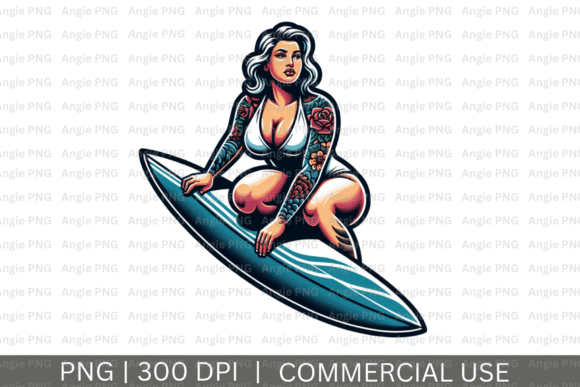
Girl and Surfboard PNG Clipart: A Versatile Design Element for Creative Projects
Whether you are a graphic designer, a small business owner printing custom merchandise, or a hobbyist building a digital scrapbook, having the right visual asset can make or break your workflow. The Girl and Surfboard PNG Clipart offers a specific, ready-to-use element that can accelerate your design process without sacrificing quality. This article walks through what this file is, where it fits into your broader creative process, and how to deploy it effectively across multiple projects.
Understanding the Girl and Surfboard PNG Clipart
This clipart is a digital image of a girl with a surfboard, saved as a PNG file with a transparent background. Unlike a JPEG, the transparent background means you can place the graphic over any color or texture without a white box around it. The file is not an SVG, so it cannot be scaled infinitely without losing resolution. However, because the PNG format supports high resolution and millions of colors, you can resize it within reason and still maintain crisp edges for most print and web uses.
Key characteristics:
- Transparent background – ideal for layered compositions.
- Raster format – pixel-based, best for fixed-size applications.
- Not an SVG – requires raster editing software (Photoshop, GIMP, Procreate, etc.) for resizing and modification.
- Color may vary slightly between monitors and printers, so test prints are advised.
Understanding these traits from the start prevents frustration. If your workflow depends on infinitely scalable vectors, you would need an SVG. But for many real-world projects, a high-quality PNG provides the perfect balance of detail and ease of use.
How the Clipart Fits into Your Creative Workflow
The Girl and Surfboard PNG Clipart can be integrated at different stages of a project. It is not a one-size-fits-all asset; instead, it works best when you plan its use around your specific process.
Before the Project: Planning and Asset Preparation
When you are outlining a design – say a summer-themed t-shirt line or a set of blog graphics – you might begin by collecting elements. This clipart can serve as a focal point or a supporting illustration. Because it is a single, self-contained graphic, you can quickly drop it into mood boards or layout drafts. At this stage, you are testing composition: how the girl and surfboard look against potential background colors, text placements, or other graphics.
Workflow tip: Download the file and open it in your image editor immediately. Check its dimensions and resolution. Most standard PNGs are 300 DPI for print or 72 DPI for web, but verify. If you need to enlarge it significantly, plan for potential pixelation and consider using it at a smaller size or as part of a larger pattern.
During the Project: Active Implementation
Once your project moves into the production phase, the clipart becomes a direct tool. For example, you might design a beach-themed invitation set. Import the PNG into your design software (Canva, Adobe Illustrator, Affinity Designer, etc.). Because it has a transparent background, you can layer text or other shapes behind or in front. You can also recolor the image using adjustment layers or color overlay effects, though the original artwork’s linework will remain visible.
Implementation examples:
- T-shirt design: Place the clipart on a colored shirt mockup. Use blending modes to match the fabric texture. Ensure the transparency is intact for a seamless look.
- Sublimation blank: For mugs or bags, import the PNG into your sublimation software. Resize to fit the print area. No background means no hard white edges on the final product.
- Digital scrapbook page: Use the clipart as a layered element. Add shadows or outlines to give depth. Combine with other PNG elements (waves, sun, text).
- Blog header: Open in your CMS or image editor. Adjust dimensions, add a background color that complements the clipart’s colors, and upload.
Important note: The file is a single layer. If you want to separate the girl from the surfboard, you will need to manually cut them using selection tools. The original PNG does not come with separate layers – it is a composite image. Plan your edits accordingly.
After the Project: Review and Quality Control
After you have placed the clipart into your design, review the final output. Check for resolution issues – if your file looks blocky when printed, start over with a larger base PNG or accept the pixelation as a stylistic choice. Since colors may vary between devices, compare how the clipart appears on your screen versus a proof print. If you are selling products, consistency matters. Save a master version with the clipart at the appropriate size so you can reuse it without repeated adjustments.
Practical Integration with Other Tools and Platforms
The Girl and Surfboard PNG Clipart interacts with various software and workflows. It is not a standalone product; its value multiplies when combined with other resources.
Design Software Compatibility
PNG is one of the most universally supported image formats. You can insert it into:
- Adobe Photoshop / Illustrator (place the PNG as an embedded or linked file)
- Canva (drag and drop from your computer)
- Procreate (import to a layer)
- GIMP (open as a new layer)
- Microsoft Word or PowerPoint (insert picture – works for simple layouts)
- Web design tools like Figma or Sketch (as an image element)
Since it is not an SVG, you cannot edit paths or nodes directly. However, you can use raster effects like masks, gradients on top, or even trace it manually to create a vector version if you need scalable edits in the future.
Printing and Production Considerations
For physical products, the transparent background is a huge time-saver. Direct-to-garment (DTG) printing, sublimation, and screen printing all rely on clean artwork. With a transparent PNG, you avoid the need to manually remove a background. But remember: if you print the clipart on a light-colored shirt, the transparent areas will show the shirt color – perfect. On a dark shirt, if your printer cannot handle white ink, the transparent areas may show no color, leaving the shirt fabric visible. Test your printer’s capabilities.
Quality control tip: Always check the clipart at 100% zoom in your design software before sending to print. Look for any jagged edges or artifacts from compression. If the file looks soft, you may need to sharpen it slightly.
Organizing and Reusing the Clipart for Efficiency
Once you have downloaded the Girl and Surfboard PNG Clipart, store it in a dedicated folder for design assets. Tag or name it descriptively – “girl_surfboard_summer_clipart.png” – so you can find it later. If you modify it (e.g., recolor or crop), save a copy with a version number. This prevents confusion when you revisit the project months later.
For long-term use, consider converting the PNG to a different format when appropriate. For web use, you may want to compress it to a smaller file size using tools like TinyPNG. For print, keep the original high-resolution version. Avoid repeated resizing because each transformation degrades quality.
Common Mistakes and How to Avoid Them
1. Treating the PNG as an SVG
Some users expect to be able to scale the graphic to billboard size without loss. That is not possible with a raster PNG. Know your project’s final dimensions before you start. If you need vector flexibility, you can manually trace the image in Illustrator, but that takes time.
2. Ignoring color variation
The notice about colors varying between devices is not just legal jargon. Calibrate your monitor or at least output a test print before mass-producing. A beach scene may shift from warm to cool tones depending on your screen and printer profile.
3. Using the clipart without respecting the license
Always double-check the usage rights that come with your purchase. Many clipart files allow commercial use, but some restrict reselling the original file or using it in logo designs. Know the terms.
4. Overcomplicating the workflow
You do not need advanced software to use this clipart. If you only need to place it on a simple background, even a basic photo editor can handle it. Do not jump into a complex tool if the task is straightforward.
Real-World Workflow Example: Launching a Small T-Shirt Line
Let’s walk through a typical process for a small business owner using this clipart.
- You purchase the Girl and Surfboard PNG Clipart and download the file.
- You open it in Photoshop and adjust its size to fit on an adult t-shirt (approx. 12 inches wide at 300 DPI). The original resolution is 1500×1500 pixels – enough for a 5×5 inch print.
- You create a composition: clipart centered, with “Summer Vibes” text below using a complementary font. You add a soft wave pattern behind it using a separate PNG.
- You save the final design as a layered PSD for future edits and flatten a copy for print submission.
- You upload the flattened PNG to a print-on-demand platform. The transparent background ensures the design shows correctly on a white or light-colored shirt.
- After receiving a sample, you notice the colors appear slightly muted. You open the original clipart and adjust its saturation, then regenerate the print file. Lesson learned: always order a proof.
- Once satisfied, you list the product. For future designs, you can reuse the clipart with different backgrounds, text, or arrangements – each iteration takes less time.
This example shows how the clipart fits before (planning), during (designing), and after (revision and reuse) the project lifecycle.
When Not to Use This Clipart
There are situations where a PNG clipart is not the best choice. If you are designing a logo that must scale from a favicon to a billboard, you need vector artwork. If you are creating a very large mural or sign, a PNG at the needed resolution would be massive and slow to work with. In those cases, an SVG or an AI file would be superior. Also, if you lack basic raster editing knowledge, you may struggle to isolate elements or adjust colors. The file assumes you have the software and skills to handle a PNG – if not, allocate time to learn or choose a more automated solution.
Final Observations on Long-Term Use
The Girl and Surfboard PNG Clipart is not a one-off asset. It can become a core part of your design library for summer-themed projects. Over time, you might collect complementary elements: palm trees, waves, beach backgrounds, text overlays. By storing and naming your assets consistently, you build a personal resource that speeds up future work. Efficiency comes from preparation: knowing the file’s limitations (raster, not scalable infinitely) and strengths (transparent, high-res, easy to layer). Use it where it shines, and your creative process will stay smooth.
Remember to test on your intended output before full production. Colors vary, resizing has limits, and your specific use case may demand a custom edit. But with a bit of planning, this clipart can save you hours of drawing or sourcing a similar illustration from scratch.